






Moving Abroad Is No Longer Just an Individual Decision
In the past, moving abroad was mostly a personal choice made by individuals. Today, however, things have changed. Many people now take this step not only for their own careers but also for their families’ future.
Relocating to a new country represents an entirely new experience for spouses and children alike.
Of course, moving abroad with your family is a more complex process in terms of planning.
But with the right preparation, this journey can become a truly transformative experience — both personally and as a family.
Children’s Language and Cultural Adaptation: The Fastest Learners!
One of the biggest concerns for parents is whether their children will be able to adapt to a new language and culture. However, research shows that children — especially those between the ages of 4 and 10 — learn new languages much faster than adults. They quickly build new friendships and begin using the language actively in their school environment.
Observations from families who have moved to a new country confirm this as well. Within just a few months, children are able to take part in everyday conversations comfortably, communicate with their teachers, and naturally absorb cultural differences. Moreover, this process strengthens not only their language skills but also their confidence and ability to empathize with others.
Growing up in more than one culture helps children become globally minded individuals in the future. Being able to think in multiple languages and understand different perspectives provides a significant advantage in both their academic and professional lives later on.
Education and School Systems: New Approaches for New Beginnings
When moving abroad, children’s education is one of the most critical considerations for many families. In European countries — particularly in Germany, the Netherlands, and Austria — the school system focuses on guiding students according to their interests and abilities. This approach offers a very different perspective compared to Turkey’s exam-oriented education model.
Children are supported not only through academics but also through social activities, arts, and sports. For example, in Germany, there are numerous clubs and activities that children can join after school. These environments help them practice the language while making it easier to build social connections.
Balance for Parents: Work, Language, and Family Life
Living abroad brings new roles for parents as well. The parent continuing their career often focuses on adapting to the new language and work culture, while the other parent tends to concentrate more on the children’s education and social adjustment. During this period, being patient and maintaining a balanced division of responsibilities is essential.
If both parents are working, childcare services — especially in Europe — offer great convenience. In many countries, there are government-supported nurseries, part-time after-school programs, and parental leave options. These systems make it easier for families to maintain a healthy balance between work and personal life.
Language learning is not only important for children but also a key factor for parents.
It helps all family members communicate more easily in daily life, accelerates integration into society, and strengthens their sense of belonging.

Adapting to a New Country as a Family: A Step-by-Step Journey
Adaptation doesn’t happen overnight — it develops over time. Most newly arrived families experience mixed emotions during their first months: excitement, uncertainty, and homesickness.
But each new day brings new routines and a growing sense of familiarity.
To make adaptation easier, the following steps can be highly effective:
- Participate in local community events,
- Connect with Turkish associations — but don’t limit your social circle to them,
- Communicate with other parents at school,
- Encourage your children to build social bonds with their friends.
Settling in a new country begins with respecting its culture.
At the same time, sharing your own culture is also part of contributing to the community.
This two-way learning process enriches both the family and the society.
Psychological Preparation: Migration Is an Emotional Journey
Moving to a new country is not only a physical transition but also an emotional one.
During this process, families may sometimes feel homesickness, loneliness, or the pressure to adapt.
These emotions are natural — and temporary.
For psychological adjustment:
- Maintain open communication,
- Seek professional support if needed,
- Give each family member the space to express themselves —
all of these are essential for emotional well-being.
Children sometimes adapt faster than their parents, while for adults the process can take a bit longer.
Accepting this difference as natural and supporting one another helps make adaptation easier.
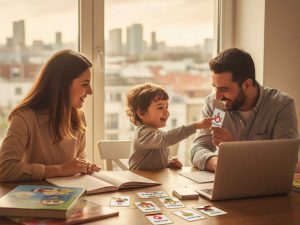
Conclusion: A New Beginning as a Family
Living abroad is not just about working in a different country; it means putting down roots as a family within a new culture.
Throughout this journey, children learn new languages and discover different values, while parents gain a broader perspective on the world.
Migration is not a story of separation, but a shared journey of growth.
Every word learned together and every new routine built as a family strengthens your resilience.
In the end, the greatest reward of living abroad is not material — it’s the passing of a vision from one generation to the next.
The children of today grow up to become more open-minded and better prepared for the world of tomorrow.
And perhaps one day, they will tell their own children:
“We crossed borders — now you embrace the world.”
